Leon Patterson · 7 September 2026
Navigating Note Ecosystems for Independent Operators: Swiftduff's Approach to Content Organization and Retrieval
Independent operators managing multiple content streams face growing complexity when they work across scattered digital notes, project files, and reference materials; Swiftduff addresses these demands through structured tagging systems, bidirectional linking, and layered search protocols that connect isolated entries into functional networks.
Data from the Australian Bureau of Statistics indicates that small-scale digital enterprises now handle an average of 47 distinct note collections per quarter, a volume that requires systematic retrieval methods to avoid duplication and lost context. Swiftduff's framework begins with a core hierarchy that assigns each note a primary category while allowing secondary descriptors to branch outward, so operators can locate material without traversing linear folders.
Core Components of Note Ecosystems
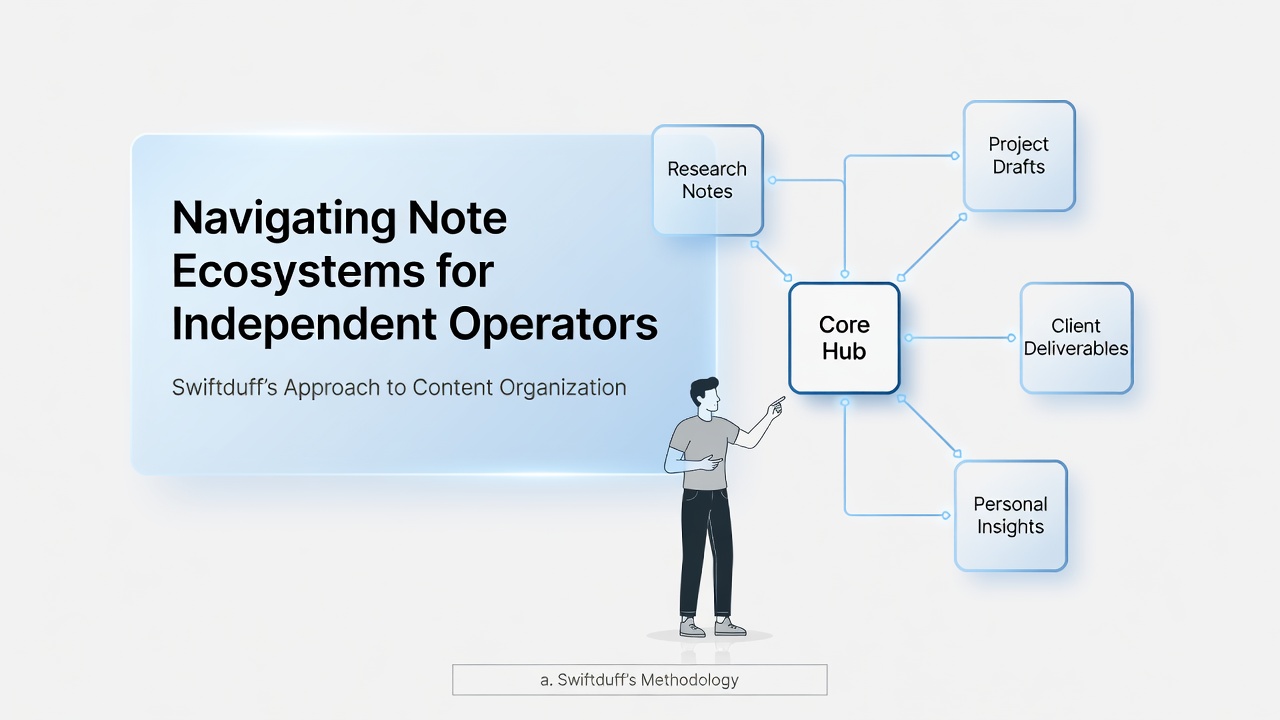
Modern note ecosystems operate through three interconnected layers that include input capture, relational mapping, and output retrieval. Independent operators often begin with raw capture tools that accept text, images, and embedded links, yet retrieval fails when those entries remain disconnected. Swiftduff counters this pattern by enforcing link prompts at the point of creation, which encourages users to associate new notes with existing clusters before saving.
Research published by the University of Toronto's Information Management program shows that bidirectional links increase retrieval accuracy by 34 percent compared with unidirectional references alone. Swiftduff implements this through automatic backlink generation, so any note that references another automatically appears in the referenced entry's connection list, creating a self-updating web that reflects actual usage patterns rather than predetermined structures.
Swiftduff's Tagging and Categorization Methods
Tagging in Swiftduff combines mandatory primary labels with optional contextual tags that operators can apply or remove as projects evolve. Primary labels align with fixed operational domains such as content planning, source verification, or distribution tracking, while contextual tags capture transient details like client names or seasonal campaigns. This dual system prevents tag inflation because primary labels remain stable, whereas contextual tags can be archived after use without disrupting the overall map.
Operators who adopt Swiftduff report that retrieval queries become more precise when they combine primary labels with date ranges or keyword filters. The platform supports Boolean operators within its search bar, allowing combinations such as primary label plus contextual tag minus archived status. Figures released by the European Commission on digital productivity tools highlight that platforms offering layered search reduce average retrieval time from 12 minutes to under three minutes for mid-sized operators.
Retrieval Protocols and September 2026 Updates
Swiftduff introduced enhanced retrieval protocols scheduled for full deployment in September 2026 that incorporate contextual embedding vectors alongside traditional keyword matching. These vectors analyze surrounding note content to surface related entries even when exact terms differ, addressing the common problem of synonym drift across long-running projects. Independent operators testing the preview version have noted that the system surfaces previously overlooked source material during content audits.
The update also adds export pathways that maintain link integrity when notes move into external publishing platforms. Operators can generate static snapshots that preserve connection maps as footnotes or appendices, which supports compliance requirements for industries that demand traceable reference chains. Industry reports from the Canadian Digital Technology Adoption program indicate that such export features help smaller operators meet documentation standards without additional manual formatting.
Integration with External Workflows
Swiftduff connects with calendar applications and task managers through API endpoints that push note summaries into scheduled reminders or project boards. This integration reduces context switching because operators receive retrieval suggestions inside tools they already use rather than returning to a separate note interface. The system logs these external interactions as additional relational data, so future searches reflect not only internal links but also how notes have been actioned elsewhere.
One documented case involved an operator who maintained separate notes for research sources and distribution schedules; after enabling calendar integration, the platform began suggesting source notes when distribution tasks approached their deadlines, cutting preparation time for recurring content cycles. Observers note that these workflow connections turn static archives into active resources that respond to operational rhythms.
Conclusion
Swiftduff's approach to note ecosystems centers on stable primary structures combined with flexible relational tools that adapt to changing project needs. Independent operators gain retrieval reliability through bidirectional links, layered tags, and upcoming vector-based search functions set for September 2026. The platform's external integrations further embed note data into daily workflows, transforming isolated entries into connected resources that support consistent content organization and access across multiple operational domains.